A working aviation safety risk platform, ready to transfer.
SRM Safety turns hazard reports and occurrence investigations into Fishbone and Bow-Tie analyses, closed-loop corrective actions and a residual risk the engine can explain. The complete codebase and IP are available for acquisition.
- Built on
- ICAO Doc 9859 and Annex 13, with SORA 2.5 for UAS operations
- Engine
- Deterministic risk engine, version 6.6, every result traceable
- Runs
- Full version entirely in the browser with self-hosted, version-pinned libraries: no third-party scripts, safety data stays on the device. The online demo keeps data in the browser and sends only the calculations to a protected server that stores no safety data
- Status
- Working prototype in invitation-only pilot testing
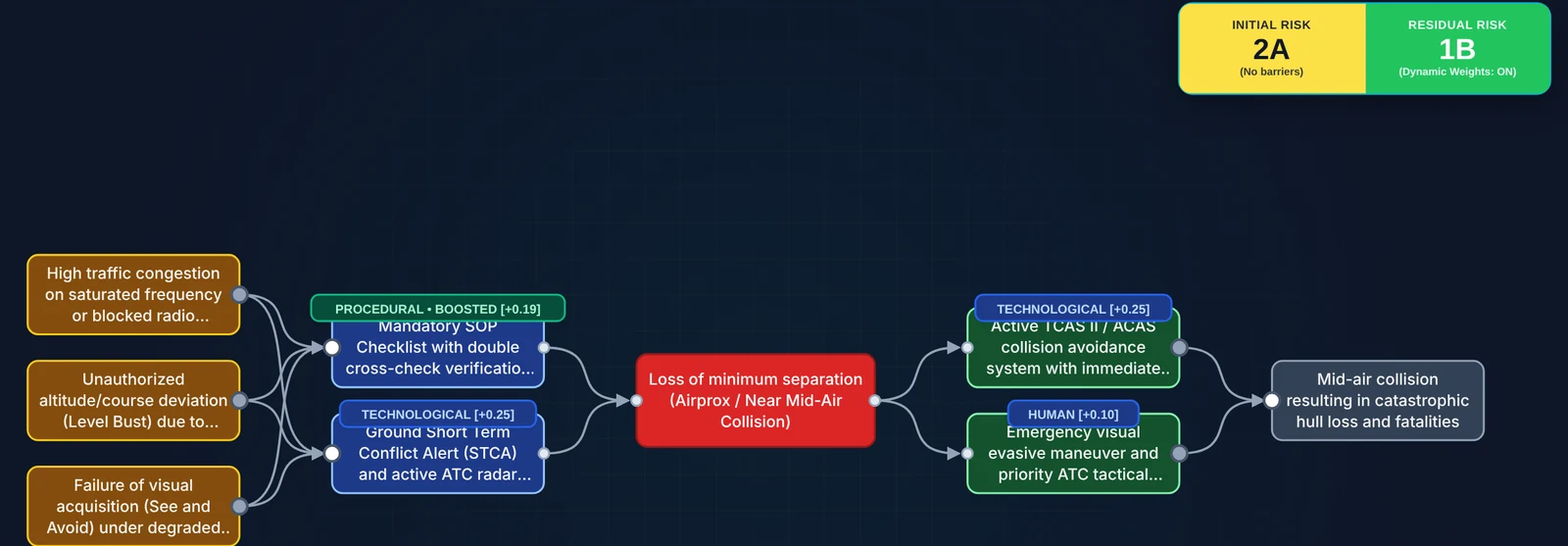
Residual risk is where audits find the gaps.
ICAO Annex 19 requires a Safety Management System, yet many risk assessments still live in spreadsheets where the residual risk is a value someone chose. When an auditor asks why a catastrophic hazard dropped to acceptable, there is often no answer beyond judgement.
SRM Safety derives the residual from the barriers actually recorded, applies the same rules every time, and shows the reasoning: which barrier counts, how much, and what an open corrective action does to it.
Asset data sheet
SRM Safety, engine v6.6, November 2026The platform, as it runs today.
Screens from the current build with a demo data set. One hazard flows through the whole chain: identification, root causes, barriers, corrective actions and performance monitoring.
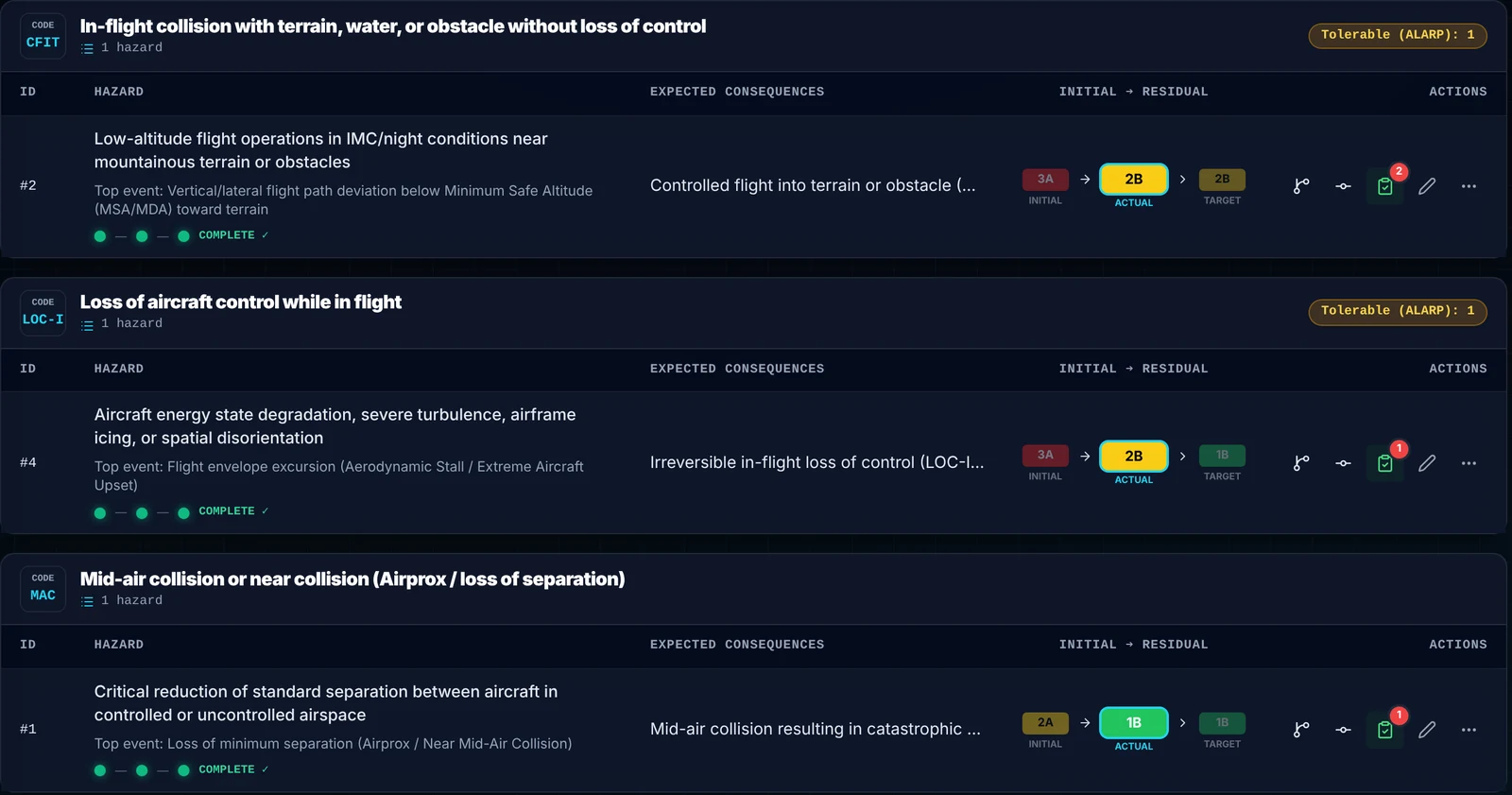
A hazard log organised by ICAO category
Every hazard carries its occurrence category, initial and current residual risk, and the state of its analysis and corrective actions.
- ICAO templates for nine CICTT categories (MAC, CFIT, LOC-I, RE, SCF-PP, F-NI, RI, BIRD, GCOL) fill threats, barriers and root causes in one step, identical in all six languages.
- The current residual is the engine's result for the Bow-Tie shown at the top of this page.
- Each row links straight to its Fishbone, Bow-Tie and corrective actions.
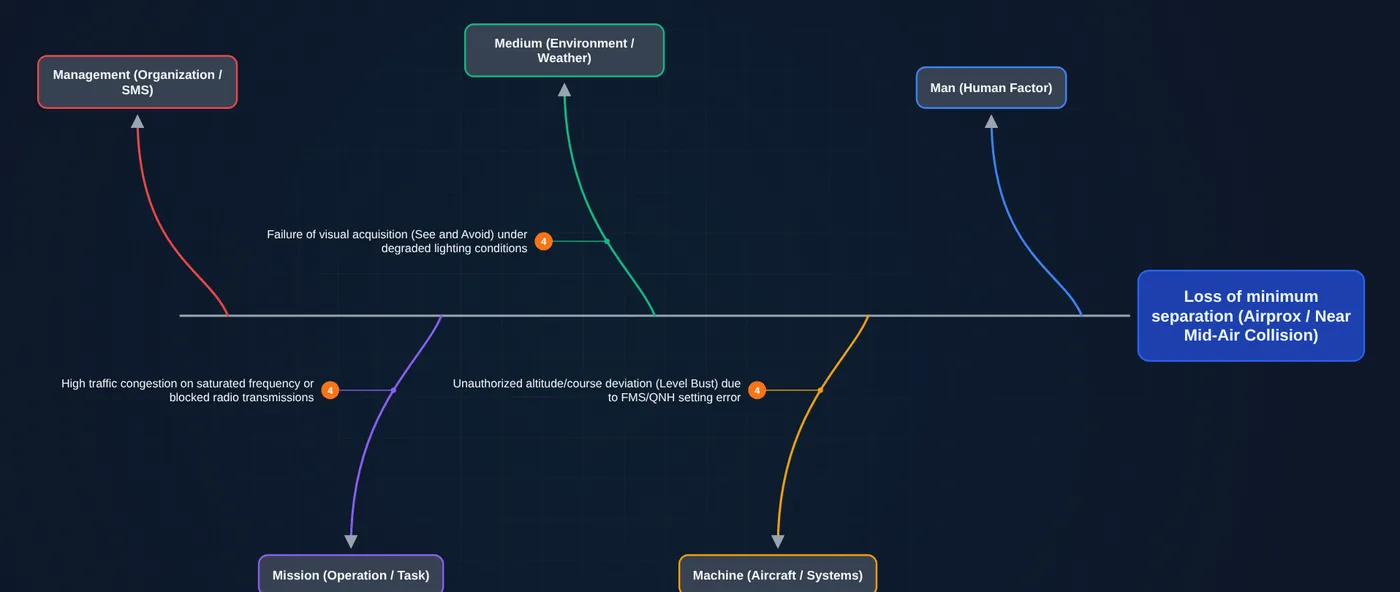
Root causes in the 5M model
The same hazard's causes sorted into Man, Machine, Medium, Mission and Management. Causes can be picked from a coded 5M factor library for crewed and UAS operations, and promoted to Bow-Tie threats, so the two analyses stay consistent.
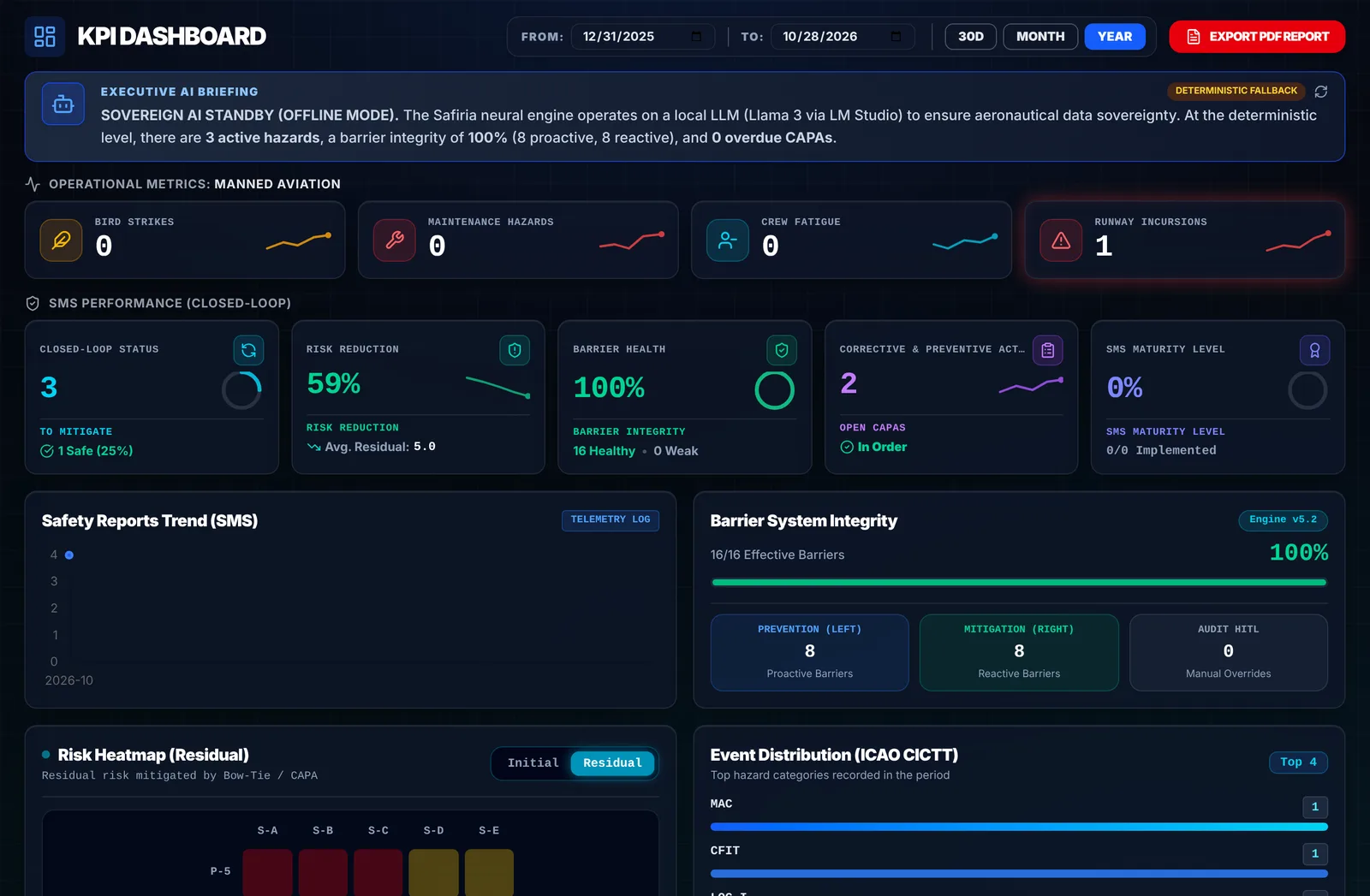
Safety performance at a glance
Closed-loop status, risk reduction across the hazard log, barrier health, overdue actions, a residual-risk heatmap and the distribution of events by ICAO CICTT category. Every indicator can be filtered by category.
SORA 2.5 for drone operations
Intrinsic ground risk from population density and aircraft class, M1 and M2 mitigations with the column floor applied, then the SAIL from the JARUS table. Operations above GRC 7 are flagged as outside SORA.
For crewed operations, a fatigue calculator checks each duty against the EASA ORO.FTL limits, or against the operator's own limits, and feeds the crew fatigue KPI.
| Final GRC | ARC-a | ARC-b | ARC-c | ARC-d |
|---|---|---|---|---|
| ≤ 2 | I | II | IV | VI |
| 3 | II | II | IV | VI |
| 4 | III | III | IV | VI |
| 5 | IV | IV | IV | VI |
| 6 | V | V | V | VI |
| 7 | VI | VI | VI | VI |
Occurrence investigation that feeds the risk
Each occurrence gets a timeline of events, classified by HFACS level and marked as fact, contributing factor or cause. The barriers that failed are linked to the hazard's Bow-Tie, so the residual risk rises until the corrective action is closed.
- Occurrence sheet with class, CICTT category and the 72-hour reporting clock of Regulation (EU) 376/2014.
- Findings and safety recommendations, each tracked through its corrective action.
- PDF report in the Annex 13 structure and an anonymised ECCAIRS/ADREP export, one row per occurrence.
- —SynopsisClass, category, aircraft, location, reporting status, linked hazard.
- 1Factual informationTimeline of events with HFACS level and role.
- 2AnalysisBarriers involved and how they performed; causes by HFACS level.
- 3ConclusionsCauses, contributing factors and other findings.
- 4Safety recommendationsAddressee, priority and the state of the linked corrective action.
Every report opens with the Annex 13 statement: the sole objective is prevention, not blame. People are referred to by role.
Why the numbers hold up.
The engine applies a small set of explicit rules, consistent with how a Bow-Tie is read. Every result can be traced back to them.
The residual comes from barriers
Templates suggest threats and barriers but never a residual value. The residual is always calculated from what is recorded.
Each barrier acts where it belongs
Preventive barriers reduce likelihood. Recovery barriers reduce severity only, after the top event.
Severe outcomes need hard defences
Catastrophic and hazardous severities come down only when each severe consequence has its own engineered or technological recovery barrier. A barrier that protects the aircraft does not lower the severity of a fall from the hoist.
Open corrective actions count
A remedial action holds its barrier at zero until it is closed. An improvement action leaves a working barrier active.
Every branch must be covered
A barrier counts only on the threat or consequence it is linked to. If a threat has no barrier, likelihood comes down by one level at most; if a consequence has none, severity does not come down.
No credit for a shared weak point
Two barriers on the same branch that rely on the same crew, procedure or equipment are discounted, and so is a near-copy of another barrier.
Fatigue limits come from the regulation
The maximum flight duty period is read from the EASA ORO.FTL table by report time and sectors, with minimum rest and cumulative limits. Other factors can only raise the level.
The words that decide are shown
Each barrier shows the class the engine detected and the terms that decided it, as it is typed and in every report.
Investigations reach the risk
A barrier found to have failed in an investigation stops counting on the Bow-Tie until its corrective action is closed.
Every result is versioned
Residuals are stored with the engine, dictionary and organisation vocabulary versions. If an update changes one, the previous value is kept and flagged for review.
What an acquirer receives.
The platform is offered as a complete asset. The scope and terms are set out in the acquisition brief.
- Source code and historyThe full application with its version history.
- Risk engine and test suitesDeterministic engine with regression tests for risk, taxonomy, 5M factors, SORA, fatigue and translations.
- Versioned safety dictionariesICAO taxonomy, barrier vocabulary and 5M factors as data files in six languages, separate from the code.
- Reports and exportsPDF reports with CICTT codes and engine traceability, investigation reports in the Annex 13 structure, Excel export and ECCAIRS/ADREP-mapped CSVs.
- Six-language localisationComplete interface translations in IT, EN, FR, DE, ES and CS.
- DocumentationCode audit report, development plan and taxonomy roadmap.
- Deployment setupFirebase configuration for the online demo, with the risk engine on a protected server endpoint and the same results as the offline full version, verified by an equivalence test suite.
- Safiria, in-browser assistantRegulatory search across curated summaries (EU 376/2014 and 996/2010, ORO.FTL, SORA 2.5, ICAO Doc 9859, 9756, 9683 and 10158), barrier class suggestions and a Bow-Tie barrier check, running entirely in the browser in the full version, after an optional one-time model download (the only request to an outside service). The platform stays fully usable without it, and in the full version safety data never leaves the device. In the online demo, its answers come from the same protected server as the engine.
Development so far, and what comes next.
Each phase was built and tested on the working platform before the next began.
- Phases 1–3
Core pipeline and closed loop
Data model, ICAO risk matrix and the link between barriers and corrective actions.
Completed - Phase 4
Safiria in the browser
Regulatory search, barrier class suggestions and a Bow-Tie barrier check (engine weights, corrective actions, investigations, barriers on the wrong side) running locally in the browser.
Completed - Phase 5
Multilingual engine v5.1
Barrier analysis in six languages and template-driven analysis set-up.
Completed - Phase 6
Methodology hardening v5.2
Code audit, SORA 2.5, fatigue thresholds, engine-calculated residuals and regression tests.
Completed - Phase 7
Taxonomy and traceability v6.0
Versioned CICTT dictionaries, 5M factor library, coded data, engine provenance in reports and an ECCAIRS/ADREP export.
Completed - Phase 8
Incident investigation
Annex 13 report, HFACS, 72-hour reporting, failed barriers linked to the Bow-Tie and an investigation KPI panel.
Completed - Phase 9
Engine v6.3 and second audit
Branch-by-branch coverage, common mode only for shared causes, stricter input handling and every library self-hosted, with independent regression cases.
Completed - Phase 10
Engine v6.4–6.6 and rotary-wing vocabulary
Rotary-wing terms in the six-language barrier vocabulary, engine core on a protected server for the online demo, a check for mitigation barriers on the preventive side, a hard defence required on each severe consequence, and a floor on weakening factors.
Completed - Phase 11
Expert calibration
Realistic scenario sets assessed independently by safety experts, used as a benchmark: every engine change is measured against expert judgement across domains.
In progress - Phase 12
Multi-user pilots
Individual user accounts and data synchronisation across devices for organisation-wide pilots.
Next
About the developer
Built by an avionics technician with 35 years in aviation and flight safety.
SRM Safety was designed from the operational side: the questions a safety manager is asked in an audit, the way barriers degrade in real operations, and the need to keep safety data inside the organisation.
The platform is now mature enough to be taken further by a team with the resources to certify, integrate and scale it.
Acquire the platform.
For aviation software companies, SMS vendors, UAS operators and investors. The acquisition brief covers the asset, its current status and the terms.
Contact: srm.dashboard.project@gmail.com
Prototype, not certified
SRM Safety is not certified by EASA, FAA or ENAC. It is provided for technology evaluation and safety management research and must not be used to support real-world operational flight safety decisions, crew licensing or airworthiness dispatch. Hazard data is stored on the user's device. In the full version it is also processed there and never leaves the device; in the online demo only the calculations go to a protected server that stores no safety data. Safety data is never sent to an external AI service. This website uses Google Analytics to count visits; safety data is never part of it.